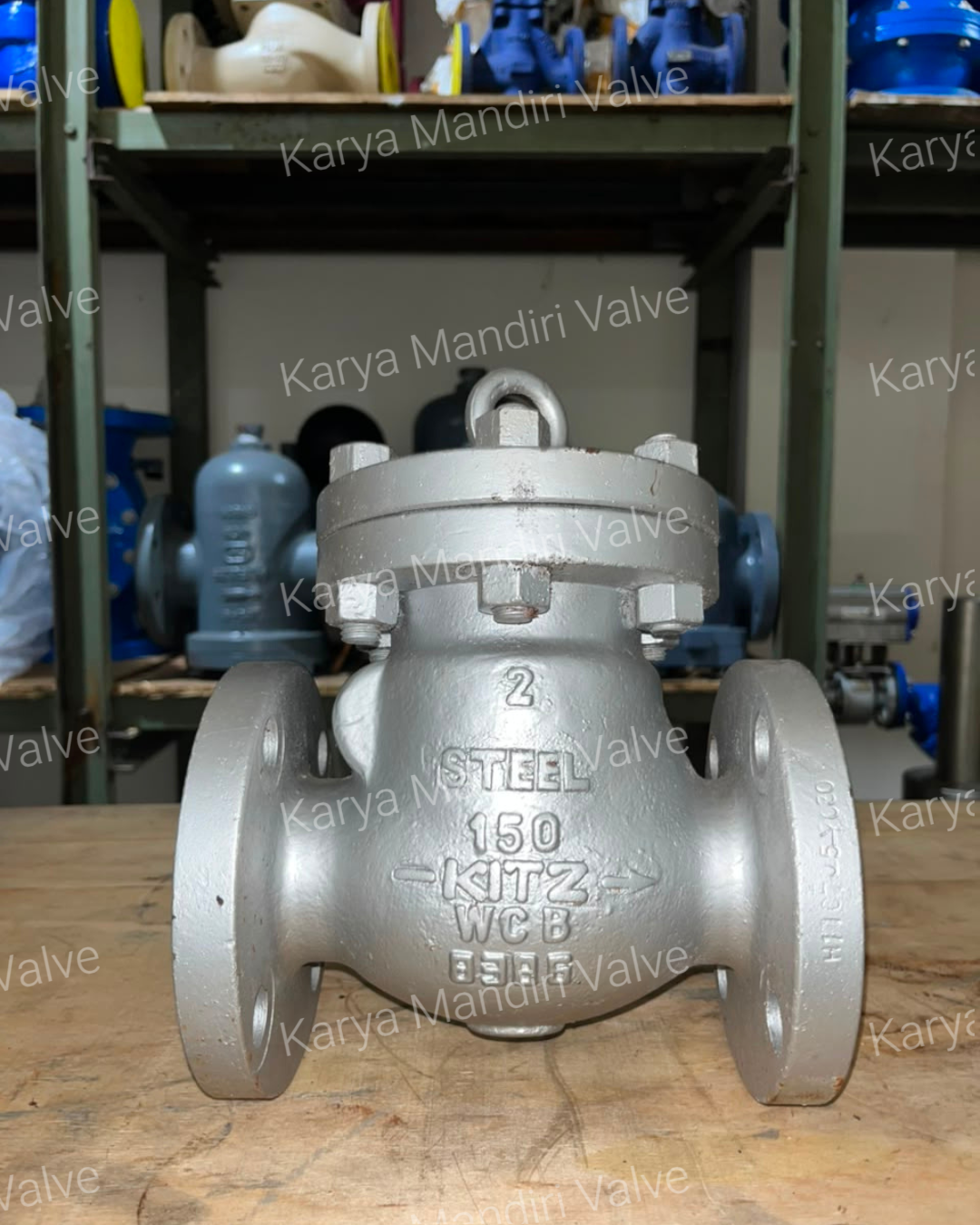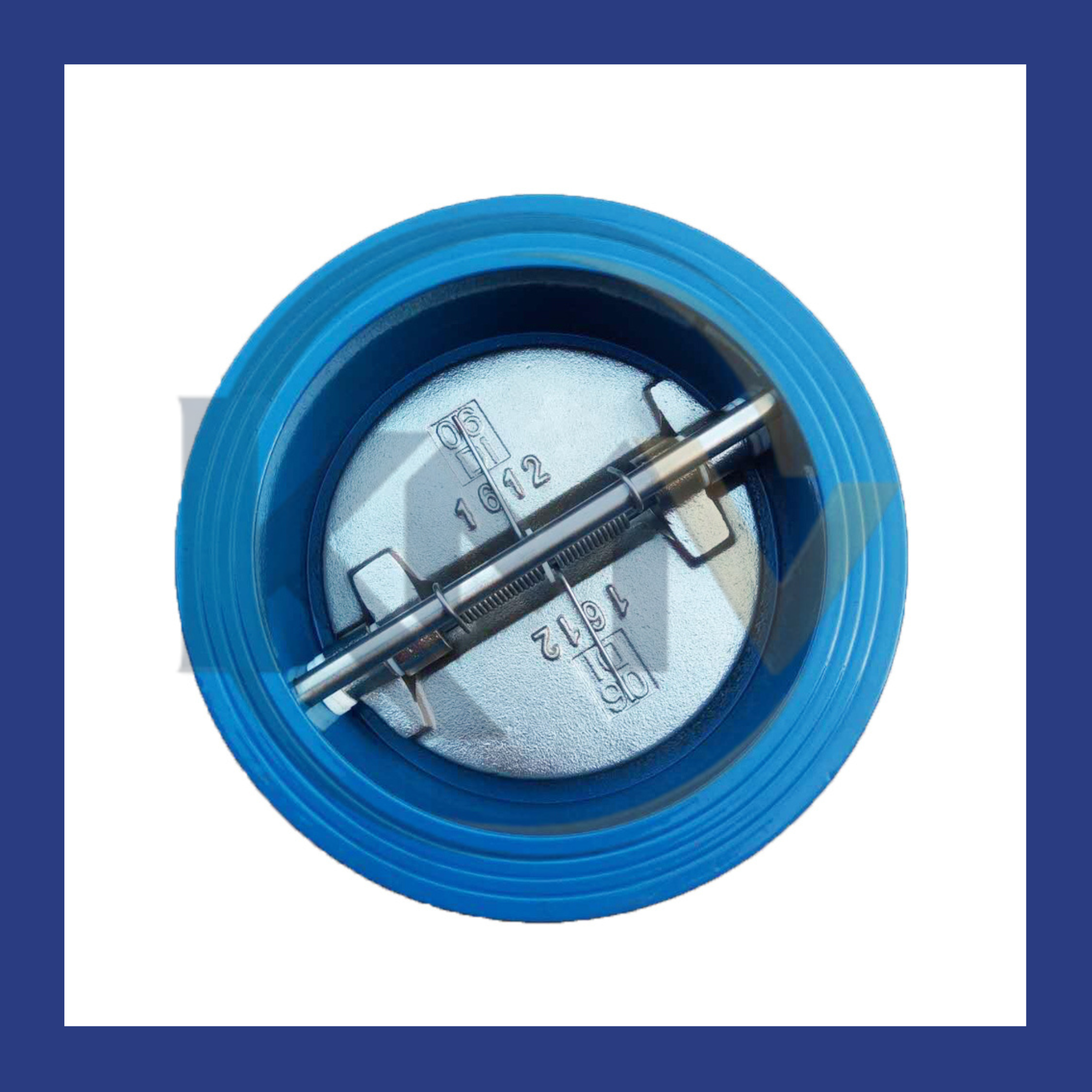
Swing, Lift, Dual Plate & Wafer Type
Check Valve is a one-way valve that functions to prevent backflow in piping systems. This valve opens automatically when forward flow pressure occurs and closes automatically when flow stops or backflow occurs, protecting equipment and pipes from damage caused by excessive back pressure.
Check Valve is an automatic valve designed to allow fluid to flow in only one direction and prevent backflow. Unlike gate valves or globe valves, check valves operate automatically without requiring a handle, handwheel, or external actuator — relying solely on flow pressure differences and gravity or internal springs as the driving force.
When forward flow passes through the valve, flow pressure will push the closing element (disc, clapper, or ball) to open. When the flow stops or backflow occurs, the closing element will close automatically by gravity, spring, or the back pressure itself. This process occurs instantly without manual intervention.
Karya Mandiri Valve provides Check Valves in various types, materials, and sizes to meet your piping system needs. All products are equipped with material certificates (MTC) and test certificates to ensure quality and reliability.
Select a tab to view details of types and pressure classes.

The closing element (clapper/disc) swings on a hinge. Flow opens the disc with forward pressure and gravity closes it when flow stops. Most commonly used on large horizontal pipes.

Disc moves up and down (lift) linearly in the direction of flow. Suitable for vertical pipe installations. Provides a tighter seal compared to swing type at high pressures.

Uses two half-moon shaped spring-loaded discs. Lightweight, compact, and fast response. Popular for oil & gas applications and utility systems.

Thin design without flange, installed between two pipe flanges using stud bolts. Saves space, lightweight, and lower installation costs.

Disc tilts from a pivot point. Opens faster and closes with minimal impact (non-slam). Ideal for applications with frequent flow changes (pump discharge).

Uses a nozzle and baffle plate to dampen flow velocity during closure, resulting in almost silent operation. Often used in water systems and HVAC.
Note: The pressure values above are the pressure ratings at ambient temperature (~38°C). Actual pressure ratings will decrease as operating temperature increases according to the ASME B16.34 curve. Class 150#–600# is generally used for utility & water system applications, Class 900#–1500# for oil & gas, while Class 2500# is for high-pressure applications.
| Specification | Detail |
|---|---|
| Type | Swing, Lift (Piston), Dual Plate, Wafer, Tilting Disc, Silence (Nozzle) |
| Size | ½" s/d 48" (DN15 s/d DN1200) |
| Pressure Class | ASME 150# – 2500#, PN 10 – PN 100, JIS 10K – 63K |
| Body Material | Cast Iron (FC25), Ductile Iron (FCD450), Carbon Steel (WCB/A216), Stainless Steel (CF8M/A351), Bronze (C84400) |
| Disc / Trim Material | SS304, SS316, SS316L, Bronze, Monel, Hastelloy, Inconel, Duplex |
| Seat Material | EPDM, NBR, Viton, Metal Seat (SS316), PTFE |
| Connection Type | Flanged (ASME B16.5), Wafer (ASME B16.42), Threaded (NPT/BSP), Butt Weld |
| End Connection Face | Raised Face (RF), Flat Face (FF), Ring Type Joint (RTJ) |
| Standard | API 594, API 602, BS 1868, ASME B16.34, JIS B2074/B2084, DIN EN 12288 |
| Operation | Automatic (based on flow pressure and gravity) |
| Certificate | Material Test Certificate (EN 10204 3.1), Test Certificate, Dimensional Certificate |
Contact our sales team. Send your specifications and we will provide the best offer within 24 hours.